
MCM Concrete · September 8, 2026 · ICF Foundations & Walls
ICF vs Poured vs Block Foundations in Minnesota
In short: All three foundation types work in Minnesota when they sit on footings at frost depth. ICF costs the most up front but delivers an insulated, finish-ready basement wall in one step, which pays off on a finished or heated lower level. Poured concrete is the strongest and fastest bare wall and the default for most new homes. Block is the right answer for repairs, small frost walls, and matching existing work. If the basement will stay unfinished and unheated, ICF is usually not worth the premium.
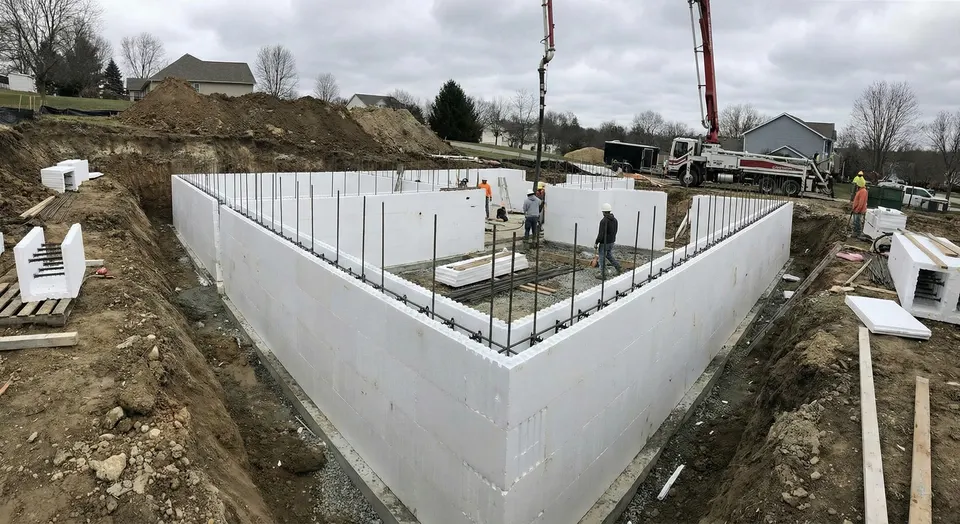
In short: All three foundation types work in Minnesota when they sit on footings at frost depth. ICF costs the most up front but delivers an insulated, finish-ready basement wall in one step, which pays off on a finished or heated lower level. Poured concrete is the strongest and fastest bare wall and the default for most new homes. Block is the right answer for repairs, small frost walls, and matching existing work. If the basement will stay unfinished and unheated, ICF is usually not worth the premium.
We build all three, so we do not have a favorite to sell you. We have a favorite for each kind of job, and that is what this post is about.
What each one actually is
A poured concrete foundation is built with removable aluminum or wood forms. We set the forms on the footing, place rebar, pour the wall, strip the forms a day or two later, and the result is a solid concrete wall, usually 8 inches thick for a basement. It has no insulation of its own.
An ICF foundation, short for insulated concrete form, uses hollow foam blocks that stack like oversized building blocks. Rebar goes in the cavity, concrete is pumped in, and the foam stays in place forever. The result is a poured concrete core with a couple of inches of rigid insulation bonded to both faces and plastic furring strips embedded in the foam for attaching drywall or siding. Our ICF walls page goes into the products and process.
A block foundation is laid up one concrete masonry unit at a time on the footing, with mortar joints and, in most cases, rebar and grout in the cores. It is the oldest of the three methods and still has real uses.
Every one of them sits on a footing that goes to 42 inches in Wright County and the surrounding counties under Minn. R. 1303.1600. The footing does not care what wall goes on top of it.
ICF vs poured concrete foundation: the honest comparison
This is the choice most people building a new home are weighing, so it gets the most space.
Strength. Both are reinforced poured concrete. A standard ICF wall has a 6- or 8-inch concrete core, and a poured wall is typically 8 inches. Against backfill and frost pressure they perform similarly when designed for the same loads. Neither one is the weak link.
Insulation and energy code. Minnesota’s residential energy code requires foundation walls to be insulated. A poured wall meets that with rigid foam on the inside or outside plus a framed and insulated wall, or with spray foam. An ICF wall meets it out of the box, with continuous insulation on both faces and no thermal bridging through studs. In a heated basement, that difference shows up in the gas bill and in how the lower level feels in January. Cold basement walls in a poured foundation are the reason so many Minnesota basements feel damp and chilly even when the furnace is running.
Finish readiness. An ICF wall has furring strips in the foam every 6 to 8 inches, so drywall screws directly to it. A poured wall needs foam, a vapor strategy, and a stud wall before drywall. If the basement is going to be finished, that framing and insulation is a real cost the poured wall has to carry and the ICF wall already includes.
Cost. The ICF wall itself costs more than a bare poured wall. Foam forms cost more than renting aluminum forms, and stacking and bracing them takes labor. The fair comparison is finished wall to finished wall. On a home with a finished, heated basement, the insulation and framing a poured wall needs closes most of the gap. On a basement that stays unfinished, the ICF premium stays a premium.
Speed. Poured walls go faster on a standard rectangular basement. Forms go up in a day, the pour happens, and the forms come off in a day or two. ICF takes longer to stack and brace, especially on the first job for a given crew. On a complex footprint with lots of corners and windows, the gap shrinks because both methods slow down.
Cold weather. ICF has a practical edge in Minnesota. The foam insulates the fresh concrete, holding in the heat of hydration and letting the wall cure in colder air than a bare wall could. We still protect the top of the wall and use accelerators when it is cold, but ICF stretches our foundation season further into November.
Walkouts and lake lots. Around Cokato Lake, the lakes near Annandale, and the lake country north toward Monticello, a lot of new homes are walkouts with a tall exposed wall on the downhill side. That wall is where ICF is at its best: it is insulated on the exposed face, ready for siding attachment, and comfortable inside. A poured walkout wall needs exterior insulation and a finish over it, or it becomes the coldest room in the house.
Where block still wins
Block gets dismissed in a lot of comparison articles, and that is a mistake. We lay block for good reasons.
- Small walls. A frost wall under a 12-by-16 addition, a stoop, or a short garage foundation is a lot of mobilization for poured forms and a pump. A mason can lay it in a day with a mixer and a pallet of block.
- Repairs and additions. When the existing house is on block, tying new block into it is cleaner than butting a poured wall against it.
- Crawlspaces and detached garages. Low walls that will never be insulated or finished do not need the strength of a poured wall or the insulation of ICF.
- Piers and specialty shapes. Block goes where forms do not fit.
Block has downsides for full basements. The mortar joints are the weak point against water and backfill pressure, so a block basement needs careful waterproofing, proper drain tile, and grouted, reinforced cores. Tall block walls with heavy clay backfill are where we see bowed walls in older homes. For a new full-depth basement in Wright County clay, we generally steer people to poured or ICF. Our block foundation page covers when we recommend it.
Where poured concrete is the default
For a new home with a basement that will stay mostly unfinished, or where the owner plans to finish it later and wants the lowest foundation cost today, a poured wall is the right call. It is strong, fast, and every builder and inspector in the area knows exactly what to expect from it. Adding insulation later is straightforward.
Poured is also the answer for tall retaining conditions, deep backfill, and shops where the wall is a stem wall under a steel or wood-frame building and nobody will ever see or heat it.
When ICF is not worth it
We sell ICF, and we will tell you when to skip it.
A detached garage or shop on a slab does not need ICF walls. The slab is the foundation, and if you want the building insulated, insulate the framing. A heated shop with in-floor heat is the exception; there ICF frost walls keep the slab edge warm and are worth considering.
A crawlspace or a short frost wall gets no benefit from insulated forms. Use block or poured.
An unfinished, unheated storage basement on a tight budget is the clearest case. You would pay for insulation and furring you never use. Put the money in the footings and drain tile.
A framing crew that has never worked with ICF window bucks and attachment will lose time figuring it out. That is a real schedule cost. We have worked alongside plenty of builders on their first ICF job and it goes fine, but it should be a decision, not a surprise.
How we would choose on three common jobs
A new home near Cokato with a finished walkout basement and in-floor heat: ICF. The insulation earns its keep on every heated square foot, and the exposed wall is ready for siding.
A spec home in a St. Cloud development with a full basement left unfinished for the buyer: poured concrete. Lowest cost for a strong wall, and the buyer can insulate and finish on their own timeline.
A 14-by-20 addition off the back of a 1970s rambler with an existing block foundation: block frost wall. It ties into the house, it is a day of work, and forms and a pump would cost more than the wall.
The part that does not change
Whichever wall you choose, three things decide whether the foundation performs: footings at or below 42 inches on undisturbed soil, drain tile and a proper drainage plane on the outside of the wall, and backfill that is placed and compacted in lifts rather than dumped. We have seen every wall type fail from bad drainage and none of them fail from being the wrong material for the house.
If you are planning a foundation anywhere in Wright County or the corridor and want a straight answer on which wall fits the plan and the budget, we are glad to look at the drawings and tell you what we would build and why.
Want us to look at your job?
Free written estimate after we walk the site. We tell you which permit office it falls under before you fill anything out.
Questions we get asked
Is an ICF foundation better than poured concrete?
Better for some jobs. An ICF wall is a poured concrete wall with insulation built in on both faces, so it wins on energy performance and comfort in a finished or heated basement. A bare poured wall costs less and goes up faster. If you plan to finish the basement, ICF usually comes out ahead once you price the insulation and furring the poured wall would need.
How much more does an ICF foundation cost than poured concrete?
The ICF wall itself costs more than a bare poured wall because of the forms and the labor to stack and brace them. The gap narrows once you add the insulation, vapor control, and furring a poured wall needs to meet Minnesota energy code and be ready for drywall. On an unfinished basement the gap stays; on a finished one it mostly closes.
Are block foundations still used in Minnesota?
Yes. Block is common for detached garages, frost walls under additions, crawlspaces, and repairs where new work has to tie into an existing block wall. It costs less than poured concrete on small walls where mobilizing forms and a pump does not make sense. Block basements for full homes are less common now because poured and ICF walls are stronger against backfill.
When is ICF not worth it?
A detached garage or shop on a slab, a crawlspace, a short frost wall, or a basement that will stay unfinished and unheated. In those cases you pay for insulation that never earns its keep. ICF also makes less sense when the framing crew has not worked with ICF window bucks and attachment before, since that learning shows up in the schedule.
Can you pour an ICF foundation in cold weather?
Yes, and it is one of ICF's practical advantages in Minnesota. The foam on both faces of the wall insulates the fresh concrete, holding in the heat of hydration and slowing the cure in cold air. We still use accelerators and protect the top of the wall, but ICF extends the pouring season further into fall than bare forms do.